1Chapter 1 Grasping Sociology

istockphoto.com/leonello
Learning Objectives
Define sociology.
Define social inequality.
Differentiate between microsociology and macrosociology.
Explain cultural awareness.
2Let us start with a thought experiment called the “Veil of Ignorance” (Rawls 1971). First, imagine yourself in a conscious and intelligent state before your own birth. You know nothing about either the circumstances you will be born into or your individual attributes. Next, ask yourself what type of a society you would want to join. Again, you do not know whether you will be born a citizen of an affluent Western country (e.g., Belgium) or a poverty-stricken former Belgian colony in the Global South (e.g., Democratic Republic of Congo). You do not know your parents’ social class, your gender, or your race. Moreover, you do not know what talents and capabilities you will enjoy, or what the possibilities of social advancement might be for people like you. Think hard.
With their existence at stake, a rational participant in this “birth lottery” would surely want to be born into a society with an even playing field, where (even in the worst-case scenario) they have a chance to live a decent life. Specifically, a reasonable “player” would want, in any case, to have their basic needs met and to have many opportunities to reach their potential. This includes being clothed and fed even if one’s parents are not well off, having a roof over one’s head, having access to quality health care and education, not being exploited or discriminated against in the labor market, having fair access to the law, and having one’s voice heard in the halls of power (i.e., to live in a democracy and not a dictatorship). If, by doing this thought experiment, you recognized that your conditions, chances, and outcomes in life are shaped, in part, by social context and your social position relative to others, then you are starting to think like a sociologist. Keep it up!
The Veil of Ignorance thought experiment highlights that our conditions, opportunities, and outcomes are the product of an interplay between social context and individual attributes. Sociology is the academic discipline devoted to understanding this interrelationship, which also shapes our actions and innermost thoughts and feelings. In this chapter, we will learn about sociology, discover how everyone benefits from thinking sociologically, examine C. Wright Mills’ sociological imagination, and introduce some of the founders of sociology. We will also begin to build a vocabulary to discuss the main concern shared by sociologists: the sources and consequences of social inequality. Throughout, we will come to understand sociology as a global field dedicated to understanding society and changing it for the better. First, we discuss the twin commitments of sociology and how you can sharpen your sociological eye.
Setting the Stage
The objective of the Veil of Ignorance thought experiment is to minimize your personal biases when conceptualizing a just society. This allows you to think more objectively about what factors influence people’s conditions, opportunities, and outcomes in life. That, in turn, helps you think in more general terms when considering what a fair and just world would look like. The experiment, furthermore, encourages you to put yourself in other people’s shoes. Being able to think objectively about social issues (such as crime or poverty), while also being able to understand and empathize with the individuals and groups involved, regardless of background, are the hallmarks of a good sociologist.
The Veil of Ignorance thought experiment also exposes the mismatch between most people’s ideal of a fair and just society and the fundamentally unequal world we live in (see Figure 1.1).
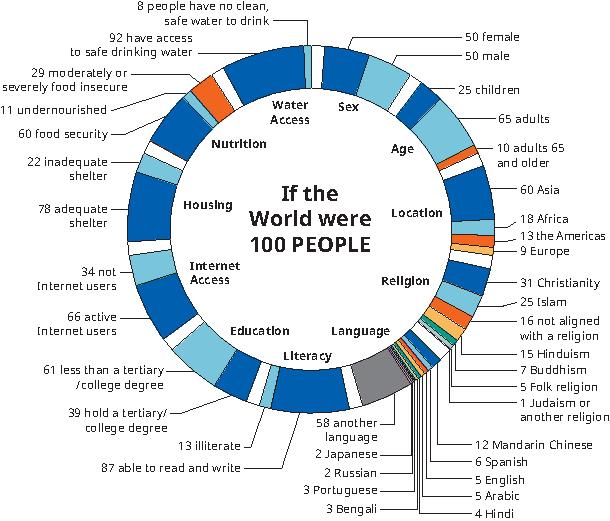
Figure 1.1 If the World Were 100 People
If the world were composed of just 100 people, 61 would have less than a college degree, 34 would not have an internet connection, 22 people would have no shelter, 11 would be malnourished, 13 would not be able to read and write, 8 and would not have access to clean water.
Source: Based on data from 100 people: A world portrait. 100people.org. (n.d.). https://www.100people.org/statistics-100-people/; based on Hagley, J. (n.d.). The world as 100 people. jackhagley. https://jackhagley.com/The-World-as-100-People.
4Sociology is particularly well suited for the purposes of understanding these disparities and patterns, as the two core commitments of the discipline are to understand the social world and to use this knowledge to change society for the better (Collins 1998). By giving you the tools to look under the surface of society to see how it operates and where improvements are needed, sociology is a powerful resource to educate engaged citizens who are capable of effecting positive social change.
The Sociological Eye, Social Structure, Social Position, and Social Inequality
To understand ourselves and our social world, we must first recognize that our lives are shaped by culture and social structure, as well as our social positions relative to others. This sociological eye (Hughes 1971; Collins 1998) is an intellectual lens that allows us to look at the social world in a critical and unbiased way, to peer under the surface to identify important social patterns and relationships. This intellectual activity is what makes sociology unique among other academic disciplines (Collins 1998). For example, the sociological eye allows us to understand how we are shaped by our culture, meaning the generally accepted beliefs, values, and norms of a given society.
The sociological eye also allows us to recognize social patterns that advantage some groups and disadvantage others. Social Structure refers to the patterned framework of society that both allows and limits opportunities and choices for different groups of people. Social structure consists of the positions people occupy in society and the relationships between these positions. Social positions exist independently of the individuals who hold them (e.g., the occupation of medical doctor). Examples of social positions include son or daughter, student, upper middle class, racial minority, gay, married, or Catholic. A person occupies several social positions; together, they shape one’s access to resources and opportunities. While the social positions one occupies influence a person’s conditions, opportunities, and outcomes, they do not determine them. Factors like talent, hard work, and coincidence also play a part.
The sociological eye is a necessary corrective to the idea (especially popular in Western countries) that people are the product of their own choices, and that success or failure merely reflect different levels of talent and drive. While individuals have agency—the capacity for voluntary action, including acting independently of structural constraints—it is important to understand that choices and actions are both constrained and enabled by conditions that are not of people’s own choosing. You have, for example, no say in when, where, or to whom you are born, yet those things profoundly shape the resources and opportunities available to you as you mature and influence your eventual outcomes. Given that, how could anyone simply be the product of their choices? Spoiler alert: no one is. So, let us broaden our horizon and look beyond individual attributes.
In order to produce more complete descriptions, analyses, and explanations of how the social world works, we need to systematically study the relationship between individuals who make choices and the social contexts that constrain and enable those choices. That is the project of sociology—an academic discipline centered on the systematic study of the interrelationship between individuals and society, emphasizing the sources and consequences of social inequality. Social inequality involves the unequal distribution of valued resources and opportunities. Valued resources include, but are not limited to income, wealth, occupation, education, power, and prestige. Opportunities refer to pathways for moving up or “getting ahead” in society (e.g., becoming educated, securing a good job, or getting rich).
5Sociology and Society

Sociology involves the systematic study of the interrelationship between individuals and society, emphasizing the sources and consequences of social inequality.
iStockphoto.com/Yuri_Arcurs
The term sociology derives from the Latin word socius, or “companion,” and the Greek suffix -ology, or “the study of.” Sociology thus literally means “the study of the processes of companionship” (Abercrombie, Hill, and Turner 2006:367). For our purposes, we define society as a group of people who interact persistently, share a common culture, live in a territory, and think of themselves as constituting a distinct entity. It is important to note that this definition does not equate society with a nation state (such as Australian or Japanese society). In fact, there are also societies within and above nation states. For example, your hometown, the LGBTQIA+ community, or Western society as a whole all constitute societies from a sociological perspective. Moreover, sociologists study every kind of social organization, from interactions in a group of two (the smallest possible human group) to global social structures (8.2 billion individuals and rising). To quote the American sociologist Howard Becker (1988), sociology is, essentially, studying “people doing things together.”
Making It Pop: Belonging and Individuality

Christopher McCandless left society to find happiness only to discover that humans find meaning through relationships with others.
BFA/Alamy Stock Photo
John Krakauer’s book Into the Wild (1996), later made into a movie, tells the true story of Christopher McCandless, who left his comfortable upper-middle class surroundings without telling his family or friends, donated his $25,000 college fund to a charitable organization fighting global poverty, and traveled solo across the western United States. McCandless struggled to find himself in a society that he saw as dominated by materialism and plagued with gross social injustices. “Chris couldn’t understand how people could possibly be allowed to go hungry, especially in this country,” said his mother, Billie McCandless (quoted in Krakauer 1993). McCandless felt pressured to chase the American Dream of material success, but he “marched to a different drummer” (Krakauer 1993). Like everyone else, McCandless wanted to be happy; and the solution he came up with was to leave society and live independent of others. McCandless’ travels eventually took him to the Alaskan wilderness. His journal suggests that after months of solitude in the wild, McCandless decided to reenter society. However, a swollen river halted his journey back. He returned to his camp and died there after accidentally eating poisonous seeds. McCandless’ story has since become something of a legend, in part, because it speaks so powerfully to the universal tension between wanting to belong and asserting your individuality. As he was dying, McCandless wrote in the pages of a book: “HAPPINESS ONLY REAL WHEN SHARED” (Krakauer 1996:189), tragically reflecting the sociological insight that people are social beings who find meaning through relationships.
6Sociology and Common Sense
Common sense is knowledge we derive from our everyday experiences, conversations, mass media, and other sources. We navigate our lives based on common sense. However, common sense is often not backed up by scientific research and can thus be flawed. In fact, while most rely on common sense, people are generally not equipped with scientific knowledge about how wider social forces shape our everyday lives. Sociology is a science that produces this knowledge. As a science, sociology is based on a body of knowledge generated through systematic study of empirical data, which is information gathered through observation and experimentation. Moreover, the “function of sociology, as of every science, is to reveal that which is hidden” (Bourdieu 1998:17). By discovering new knowledge and refining existing knowledge about the social world, sociology provides us with our most informed descriptions, analyses, and explanations of how society works.
Sociology produces scientific knowledge about human behavior using rigorous research methods such as archival research, surveys, participant observation, and in-depth interviews to uncover patterns and processes that are often hidden in plain sight, yet strongly shape our actions, beliefs, and outcomes. (We will explore the types of data and research methods sociologists commonly use in Chapter 2.) Phenomena we see as common sense or “natural” are often not so obvious when subjected to sociological analysis. In fact, a key insight of sociology is that “things are not what they seem” (Berger 1963). Systematic analysis of empirical data sometimes confirms common sense, but common-sense knowledge is much less reliable because it rests on widely held beliefs rather than the systematic analysis of data.
A good example of this is crime. Since the polling organization Gallup started asking Americans about crime in 1989, most people typically say that crime has increased from the previous year (see Figure 1.2). Specifically, in 23 of 27 Gallup surveys since 1993, at least 60% say there is more crime nationally than the year before. However, analysis of official records of recorded crime and victimization surveys (to estimate nonreported crimes) show that crime rates have fallen steadily since 1991. In fact, official records show that violent crime fell by 49 percent from 1993 to 2022 and property crime by 59 percent (Gallup 2025; Bureau of Justice Statistics 2024; Federal Bureau of Investigation 2024; Gramlich 2024). This is a classic case of sociological analysis of empirical data debunking common sense.
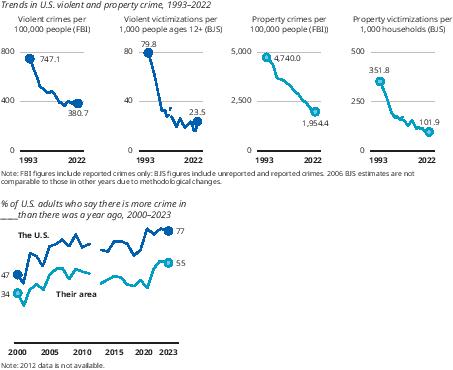
Figure 1.2 Americans’ Perceptions of Crime
Most Americans think that crime is increasing from year to year. It is not.
Source: Gramlich, J. (2024, April 24). What the Data Says about Crime in the U.S. Pew Research Center. https://www.pewresearch.org/shor
You and the Sociological Imagination
We all benefit from developing our sociological imagination, that is, the ability to connect individual experiences to the social and historical forces that shape our lives (Mills 1959/2000). For example, consider the factors that influenced your decision to go to college. If you were born in the United States, you may be one of more than 60% of high school graduates who enroll in 2-year or 4-year colleges in the fall immediately after completing high school (National Center for Education Statistics 2023). In fact, more than 60% of adults in the United States have completed some college (Census Bureau 2023). Thus, by going to college you are conforming to a norm, or an accepted standard of behavior in a society.
As a college student in the United States, you were also most likely born in this country in the 2000s but not 1920 when only 3.3 percent of American adults had a bachelor’s degree or higher (Snyder 1993). A lot has changed. Higher education has become more open, in no small part because of laws banning discrimination against women and racial minorities.
7One such law is Title IX. This federal law, passed in 1972, states, “No person in the United States shall, on the basis of sex, be excluded from participation in, be denied the benefits of, or be subjected to discrimination under any education program or activity receiving Federal financial assistance” (Title IX of 20 U.S.C.A §168). This law helped to level the playing field for women in higher education. Although the law did not explicitly mention athletics, it also greatly expanded opportunities for girls and women in sports. Before Title IX, girls and women were virtually excluded from most athletic opportunities in schools, such as sport-based scholarships. The new opportunities created for women students because of Title IX demonstrate how the social structure—in this case, federal laws—shapes individual outcomes.

The passing of Title IX was a watershed moment for women’s athletics in the United States.
ZUMA Press, Inc./Alamy Stock Photo
8Last, as someone already in college, it is likely that your family’s income is higher than the median family income in the United States. In this country, people’s chances of enrolling in college increase with household income. Moreover, the relationship is remarkably linear.
Differences between the rich and poor, however, are even more pronounced when we look at college completion rates: Children from families with incomes in the top 25 percent are six times more likely to graduate college than children from the bottom 25 percent (Bailey and Dynarski 2011). All things being equal, whether one completes college or not can have major implications. In 2023, the median weekly earnings for American workers ages 25 and over with bachelor’s degrees was 66 percent higher than for people with a high school degree. The unemployment rate among workers with bachelor’s degrees was also significantly lower (2.2%) than among those with only a high school degree (3.9%) (U.S. Bureau of Labor Statistics 2024).
The Sociological Imagination
To better understand yourself and your social worlds, you must use your sociological imagination. American sociologist C. Wright Mills (1959/2000:3) coined the term “the sociological imagination” and described it as the ability to understand how your biography intersects with history; it is “the vivid awareness of the relationship between personal experience and the wider society.”

C. Wright Mills was a professor of sociology at Columbia University.
Hulton Archive/Staff/Hulton Archive/Getty Images
By stepping back and looking at the big picture, the sociological imagination reveals that what might at first seem to be simple, personal problems (such as the struggles of a first-generation college student) might in fact be better understood as an issue of social significance (such as the achievement gap between first-generation and continuing-generation students in the midst of growing economic inequality). Instead of defaulting to individualistic explanations (e.g., “I am not college material”), the sociological imagination can help first-generation and low-income students realize that they typically confront greater economic, cultural, social, and psychological barriers than continuing-generation students. In fact, a study suggests that simply learning about the different challenges they face in college based on their background helps incoming first-generation students transition and perform better academically and closes the social-class achievement gap (Stephens et al. 2014).
9Studies show, for example, that 1 in 10 students experience homelessness during college and as many as half do not have secure, regular access to affordable and nutritious food (Goldrick-Rab 2019). In other words, many less-privileged college students are literally trading food and shelter to afford ever rising tuition, and some have devised other extraordinary coping strategies in the face of this struggle (McMillan Cotton 2017). In this sense, and many others, colleges can work to maintain inequality and poverty (Armstrong and Hamilton 2015). Considering this, Sara Goldrick-Rab (2016), who does research on food and housing insecurity in higher education, advocates for practical, powerful ways to get college administrators and professors to use their sociological imaginations and come up with straightforward solutions, like food pantries for all students, improving the financial aid application process, and making college more affordable, if not free, for first-generation students. The sociological imagination empowers us as individuals and as a society to make more informed decisions about what we want and how to get there.

Students selecting groceries at the Stony Brook University food pantry.
ASSOCIATED PRESS
Some people resist the sociological imagination because it requires them to critically assess their assumptions and preconceived notions. As Mills (1959/2000) himself noted, the “first lesson” of sociology and the sociological imagination “is the idea that the individual can understand her experience and gauge her fate only by locating herself within her period, that she can know her own chances in life only by becoming aware of those of all individuals in her circumstances. In many ways it is a terrible lesson; in many ways a magnificent one.” The lesson is “terrible” because it forces us to realize that we are influenced by—even at the mercy of—social forces beyond our control. The “magnificent” lesson, however, is knowing that we are not alone in our struggles. Moreover, the sociological way of knowing empowers us to make more informed choices about how to live our individual and collective lives, and to change society for the better.
Nothing activates a person’s sociological imagination more than when their taken-for-granted social reality is turned upside down. The greatest social crisis of recent years, for example, the COVID-19 pandemic—resulting from the deadly corona virus disease—shows that personal troubles following the onset of the pandemic, such as increased poverty, loneliness, and unemployment, are unquestionably public issues—fallout of the crisis (Mills 1959/2000). Moreover, the infectious disease, which spreads through human contact, made it painfully clear to everyone needing to isolate themselves from others that humans are “essentially social beings. We cannot exist alone. We are products of culture and collective labor” (Matthewman and Huppatz 2020:3). The pandemic also crystalized preexisting social inequalities, evidenced, for example, by the fact that the age-adjusted COVID-19 mortality rate for African Americans was at one point 3.6 times higher than for White Americans, and for Native Americans the rate was 3.4 times higher (APM Research Lab 2020). Amid death, sickness, and despair, however, there is hope, as collective adversity also engenders social solidarity (Solnit 2009). Everyone desires connection and purpose, and many are committed to the possibility of positive social change. We saw many examples of this during the COVID-19 pandemic, from volunteers ferrying essential medical workers between hospital and home in Wuhan, China, to the many volunteers around the world picking up medical supplies for the elderly. Moreover, amid tragedy, most were optimistic that we would emerge from the pandemic a kinder and more communitarian society (Lourens 2020).
Movers and Shakers: Forerunners of Sociology

“Consideration for others is the basis of a good life, a good society” (Confucius).
iStockphoto.com/XiXinXing
10Sociology is comparatively young as an academic discipline. Sociological thinking about the interrelationship between society and the individual, however, dates back to at least the ancient Chinese thinker, educator, and political figure, Confucius (551–479 BC), a foundational figure in Eastern philosophy. Confucius’ collected works, the Analects, contain speculations about humans as social beings, how individuals are shaped by society and vice versa, sources of and solutions to various social problems, and what it means to be a moral person.
The Greek philosopher, Plato (428–348 BC), a pivotal figure in Western philosophy, also postulated about the nature of society and how to conduct oneself wisely within it. Plato’s Republic, for example, addresses questions about social relations, just forms of government, and how to behave as a just person in society. Neither Confucius nor Plato, however, engaged in systematic analysis of empirical data, relying instead on deep thinking, dialogue, and logical reasoning. The philosophies of both thinkers have been tremendously influential across the ages and continue to shape our thinking to this day on everything from ethics and education to justice and politics.
The Founding and Founders of Sociology
Sociology was founded by social scientists who wanted to understand the fundamental social changes taking place during their time and use this knowledge to improve society. These scholars realized that the best possible interpretations and explanations of how society really works would require systematic study of social phenomena using empirical data.
Ibn Khaldun
The first scholar to propose and practice something resembling sociology was the Tunisian historian, Ibn Khaldun (1332–1406). As such, Khaldun is an important forerunner of sociology. Moreover, a case has been made that Khaldun’s seminal book The Muqaddimah (1377) makes him the “founding father of scientific thought on the dynamics of human societies” (Dhaouadi 1990:319). Nothing like The Muqaddimah had been produced before: a rigorous study of human society using systematic analysis of empirical data to produce a theory of how societies evolve. In fact, The Muqaddimah has been described as “the greatest work of its kind that has ever yet been created by any mind in any time or place” (Toynbee 1962:322).

Ibn Khaldun
iStockphoto.com/GeorgiosArt
Khaldun, who lived during a time of great crisis in Arab-Muslim societies, wrote The Muqaddimah to represent his scientific attempt to understand and explain the social forces at play. He argued that earlier scholarly methods lacked rigor and only described events. Khaldun, however, wanted to understand how and why events came about. He proposed his `Ilm Al `Umran (Arabic: “science of civilizations”) to allow people to better understand society. Khaldun was convinced that his approach represented a breakthrough. Writing about The Muqaddimah, he stated, “In the work, I commented on civilizations, on urbanization, and on the essential characteristics of human social organization, in a way that explains to the reader how and why things are as they are . . . As a result, this book [The Muqaddimah] has become unique, as it contains unusual knowledge and hidden wisdom” (1974 I:3–9). `Ilm Al `Umran represents the precursor to the kind of sociological thought established by Auguste Comte almost 500 years later.
Auguste Comte
11People are most aware of how they are shaped by social forces when caught up in massive social upheavals. A formidable example of such turmoil is the French Revolution (1789–1799).

Auguste Comte.
Sueddeutsche Zeitung Photo/Alamy Stock Photo
French philosopher Auguste Comte (1798–1857) grew up following the French Revolution. Comte wanted to understand the massive social changes occurring as aristocracy gave way to democracy; new technologies gave rise to new industries; people transitioned from villages and farming to cities and factory work; and society increasingly looked to scientific explanations for how the world works. Ultimately, however, Comte wanted to help France (still reeling from the Revolution) stabilize and prosper. Comte’s solution was positivism—a philosophy of science focused solely on scientifically determined facts—and he sought to apply the scientific method of the natural sciences to the study of society. Comte modeled this new social science on physics and originally named it “social physics,” later renaming it “sociology.”
Comte theorized that individuals and societies alike pass through three stages in their search for knowledge: the theological, metaphysical, and positivist stages. In the final positivist stage, people have progressed from believing in the supernatural and abstract speculation to scientific reasoning based on observable facts. The sciences came into existence in a similar fashion, he argued, with the natural sciences emerging first, before man was able to take on the more complex science of human society. This placed sociology atop the science hierarchy, and Comte referred to it as the “Queen of the Sciences.”
Just as natural scientists did for the natural world, Comte argued that sociology could reveal universal “laws” of society (like the law of gravity in physics). He argued, furthermore, that sociology rested on two pillars: the study of “social statics”—the forces that hold society together—and “social dynamics”—factors that drive social change. Comte argued that sociological knowledge would improve general welfare and help society manage social changes. By laying out a theory of society and identifying appropriate methods and topics in his six-volume Course on Positive Philosophy (1830–1842), Comte laid the original foundations for sociology. Moreover, his argument that behavior is the product of both personal choice and social context remains at the core of sociology. Others would later build on Comte and advance sociology, most notably Harriet Martineau in England and Émile Durkheim in France.
Harriet Martineau
Harriet Martineau (1802–1878) was a social theorist and the first major woman sociologist. Born and raised in England, Martineau was a prolific writer, journalist, and political economist. Despite being a woman in a heavily male-dominated society, Martineau was widely read. A woman ahead of her time, Martineau essentially introduced the study of social inequality into sociology by focusing on society’s ills, including the subjugation of women and people of color.

Harriet Martineau.
Chronicle/Alamy Stock Photo
12In true sociological fashion, Martineau traveled to the United States in 1835 to examine American democracy on its own terms rather through the lens of Eurocentrism (i.e., the tendency to interpret the world through European beliefs and values). In her book Society in America (1837/1962), Martineau concluded that the United States fell far short of its ideals by enslaving people and denying full citizenship to people of African descent, Native Americans, and women. In her study, Martineau focused mainly on race, class, and gender, and relied mostly on participant observation, prefiguring what is now a common research method among sociologists.
After her American travels, Martineau wrote the first book on sociological research methods: How to Observe Manners and Morals (1838/1989). In this book, Martineau stressed cultural relativism when studying other people, that is, the need to assess the attitudes and behaviors of people from the perspective of their own culture. The opposite of cultural relativism is ethnocentrism: evaluating the practices of other cultures based on one’s own culture. Ethnocentrism assumes that one’s own culture is normal and superior to other forms of culture. Cultural relativism, in contrast, stresses empathy and understanding that different social contexts produce different norms and values. Cultural relativism does not require you to abandon your own sense of what is right or wrong. It only requires a concerted and sustained effort to evaluate norms and values against the backdrop of the culture that gave rise to them.
Martineau introduced Comte to the English-speaking world by translating and condensing his work in the book The Positive Philosophy of Auguste Comte (1853). Comte himself preferred Martineau’s translations to his own and recommended them to his students.
Building on Comte, Martineau also argued that general social laws govern society. This included Comte’s principle of evolution and progress and that science represented the most advanced form of knowledge. Martineau, moreover, identified a very progressive principle at the time, specifically, that for societies to evolve and reach their full potential they must ensure social equality for women and other oppressed groups.
Émile Durkheim
Back in France, Émile Durkheim (1858–1917) continued Comte’s important project of establishing sociology as an academic discipline. Durkheim improved Comte’s positivist approach and proposed distinctly sociological methods in his book The Rules of the Sociological Method (1895/1982). For Durkheim, the proper subject matter for sociology was social facts: aspects of social life that are external to individuals yet shape their behavior and thoughts. Examples of social facts include religion, marriage, and the education system. These social phenomena, according to Durkheim, can be analyzed just like natural objects or events. This is reflected in Durkheim’s first principle of sociology: “Study social facts as things.”
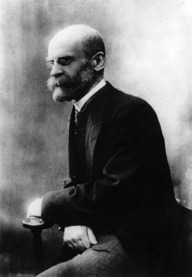
Émile Durkheim.
Pictorial Press Ltd/Alamy Stock Photo
Social and political upheaval in France, stemming from industrialization and war, inspired Durkheim to study how society operates and how it could be improved. Durkheim theorized that society evolves and functions like the human body, each with interdependent parts working for the good of the whole. This perspective is called functionalism and describes social life in terms of how different groups and social institutions contribute to social stability. For Durkheim, properly functioning social institutions (i.e., recurring and stable patterns of behavior), such as religion, are needed to ensure that people work not only for selfish reasons but also for the good of society. In fact, Durkheim (1895/1982) described sociology as the “science of institutions, their genesis and their functioning.”
13In his first major study, The Division of Labor in Society (1893/1997), Durkheim argued that the key ingredient of a prosperous society was social solidarity, or the feelings of connectedness that unite members of a social group. These bonds change as society changes. In traditional societies, individuals are bound to one another through a common way of life and tradition. In such societies, almost everyone shares the same values and beliefs and performs similar work tasks. Durkheim referred to social cohesion based on similarity as mechanical solidarity. The hallmark of mechanical solidarity is collective consciousness, that is, the common beliefs and values that unify society. Social cohesion in more complex, modern societies, in contrast, is characterized as organic solidarity. In such a society, individuals are dependent on one another because people perform different tasks and exchange goods and services. However, because the condition of organic solidarity allows more room for individuality, the bonds that hold society together are weaker. Because he saw an increasingly complex division of labor (the organization of work into specialized tasks performed by different groups) gradually replacing religion as the primary basis of social solidarity in the emerging industrial society, Durkheim argued that modern societies need effective social institutions, such as the education system, to teach its members that they are obligated to one another and to society as a whole.
Durkheim devoted his career to establishing sociology as a distinct and respected science. He founded Europe’s first academic sociology department and became the first professor of sociology in France. Durkheim’s work continues to influence sociologists around the world.
Karl Marx
Karl Marx (1818–1883) also lived through and theorized about social changes paralleling the Industrial Revolution, a period of rapid industrial development starting in the late-18th and early 19th century marked by the introduction of machinery, steam power, and mass production. Unlike Durkheim, who argued that ideas drive social change, Marx maintained that changes in the way humans produce the means of their existence determine how society is organized. This perspective is known as historical materialism. Unlike Durkheim, Marx argued that societies are not characterized by solidarity and consensus, but by class conflict, that is, competition between social classes over the distribution of valued resources. In contrast to Durkheim’s image of social cohesion and stability, Marx and his colleague Friedrich Engels wrote that “The history of all hitherto existing society is the history of class struggles” (Marx and Engels 1848/2013:3).

Karl Marx.
Photo 12/Alamy Stock Photo
At any time, Marx argued, a dominant class owns the means of production (resources used to produce goods and services) and exploits a dominated class of non-owners. Under industrial capitalism (a society based on private property and market-based exchange), a capitalist class owns the capital (the means of production) and exploits the working class whose members are forced to work for capitalists (typically in factories) to survive.
14Marx argued that excessive inequality and conflict are inherent to capitalism because capitalists have an interest in paying workers less than their fair share, thereby increasing their own profits. Workers, in turn, have an interest in fighting their exploitation. However, because the dominant class also shapes society’s dominant ideology—widespread ideas presenting the interests of the capitalist class as universal, legitimizing current social arrangements—workers are not aware of the extent of inequality and how badly they are exploited. “The ideas of the ruling class are in every epoch the ruling ideas, i.e. the class which is the ruling material force of society, is at the same time its ruling intellectual force” (Marx and Engels 1846/1965:61). Because the dominant class controls the production of ideas, workers are misled about their true class interests, also known as false consciousness.
Marx actively strived to help workers overcome their false consciousness and to achieve class consciousness—a collective awareness of their true class position and shared interests in transforming the economic system. Using his terminology, Marx wanted the working class to transform from a “class-in-itself” (a group of individuals with a common relationship to the means of production) to a “class-for-itself” (a collectively organized group of people in active pursuit of their interests). Here, Marx articulates his strong commitment to activism: “The philosophers have only interpreted the world, in various ways; the point is to change it” (Marx and Engels 1848/2011). Marx’s most famous attempt to raise workers’ consciousness is in the final words of the Communist Manifesto: “Let the ruling classes tremble at a Communist revolution. The proletarians have nothing to lose but their chains. They have a world to win. Workingmen of all countries, unite!” (Marx and Engels 1848/2013:35).
While Marx’s prediction of a communist revolution in a mature capitalist society proved incorrect, his analysis of capitalism (Marx 1867/1970) is very insightful and continues to inspire sociologists, whether they agree with him or not. Because of Marx’s radical ideas (he was barred from academia and exiled from his native Germany to England), it was not until the 1960s that he became accepted as a giant of sociologist thought. Marx’s contributions have had the greatest impact on conflict theory, a diverse set of theories that explain social phenomena in terms of the conflict and inequality built into social relations.
Max Weber
Max Weber (1864–1920) was another German conflict theorist whose ideas have greatly impacted sociology. Weber was influenced by Marx but rejected some of his key ideas, most notably historical materialism. Economic factors are important drivers of social change, Weber claimed, but ideas are just as important. This is evident in Weber’s most famous work, an essay titled “The Protestant Ethic and the Spirit of Capitalism” (1904/2003). Comparing religious ideas in China and India with Western countries, Weber argued that the work ethic of Protestants—most notably among Calvinists—was an important force behind the unplanned emergence of modern capitalism. A devotion to hard work and the benefits it yields, Weber theorized, represented Calvinists’ desire to demonstrate that they were predestined–that is, saved–by God’s grace.

Max Weber.
Everett Collection Inc/Alamy Stock Photo
The rise of capitalism, moreover, Weber argued, exemplified a larger process of rationalization, or the growing dominance of calculated reason and efficiency over emotions and tradition in all spheres of life. Weber saw bureaucracy as the model that society was heading toward, a process he described in Economy and Society (1922/1978), one of the most influential works of social science ever produced. A bureaucracy is a formal organization in which written rules and a clear hierarchy of authority are used to organize specialized work tasks. Weber admired the efficiency that rationalization promised, but he feared it might eventually trap people in a metaphorical cage of rationality; a state in which economic logic has crowded out emotions, traditions, and human creativity.
15Unlike Marx, Weber did not believe that capitalism was doomed to fail, to be replaced with an egalitarian communist utopia. He was pessimistic that inequality could ever be completely eliminated. Social inequality, moreover, Weber argued, could not be explained simply by people’s relationship to the means of production. Instead, Weber proposed a three-part model of inequality consisting of three ideal types: class, status, and “party” (i.e., power). An ideal type is a conceptual device that deliberately exaggerates and simplifies a social phenomenon to highlight its essence (Weber 1949). In Weber’s formulation, “class” is a group of people that possess similar amounts of economic resources. “Status groups”, in contrast, command different levels of prestige (such as respect and admiration). Finally, “party” refers to the ability to influence important decision making, such as through political affiliation. There are exceptions, but the three dimensions tend to overlap significantly. For example, members of the upper class tend to be respected and influential.
In contrast to Comte, Weber subscribed to anti-positivism, a philosophy of science that holds that the social world cannot be studied with the same methods as the natural world, given that humans act based on their subjective understanding of their surroundings and attach meaning to their actions. Moreover, unlike Durkheim and Marx, Weber did not attribute reality to social forces independent of individual action and meaningful thought. Instead, Weber was primarily interested in the individual motivations that lead to certain actions, and how these actions shape society. For Weber (1922/1964:88), sociology should be “a science which attempts the interpretive understanding of social action in order thereby to arrive at a causal explanation of its course and effects.” Using Weber’s terminology, sociologists should try to achieve verstehen—interpretative understanding—of how individuals understand the situations they find themselves in. As such, Weber’s work bridges the work of earlier social theorists, who concerned themselves mainly with large-scale structural social phenomena, and more recent work that examines small-scale individual interactions.
Like most other founders of sociology, Weber was concerned over inequality and injustice, and he took up political causes he saw as important (like promoting democracy in the face of political extremism). Weber, however, unlike Comte and Durkheim, did not see it as the mandate of sociology as a science to guide society. Importantly, Weber argued, sociologists should try to be as objective as possible and “value-free” (impartial) in their work.
W.E.B. Du Bois
William Edward Burghardt (W.E.B.) Du Bois (1868–1963) was “the first number-crunching, surveying, interviewing, participant-observing and field-working sociologist in America” (Morris 2015:47). As the first American sociologist to base his theories on rigorous empirical research, Du Bois should be considered the main founder of modern U.S. sociology. The first African American Ph.D. graduate from Harvard, Du Bois studied at the University of Berlin with the first generation of German sociologists. Despite being a prolific researcher and writer, Du Bois was marginalized in American academia and shunned by many American sociologists, some of whom accepted racist ideas. Unable to land a position at a leading university, Du Bois worked at Historically Black Universities in the South. Despite lacking enough resources, Du Bois founded the first scientific school of American sociology at Atlanta University by gathering a team of researchers to study African American communities (Wright 2016).
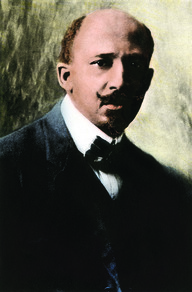
W.E.B. Du Bois.
North Wind Picture Archives/Alamy Stock Photo
Du Bois was also marginalized in part because his theories rejected what were then “common sense” and racist ideas of Black biological and cultural inferiority. Du Bois used painstaking research to demonstrate that high rates of poverty and other social problems among African Americans stemmed primarily from White Americans’ racial prejudice and racial discrimination that denied Black people equal opportunities. In Du Bois’ words, racial inequality “derived from exploitation, domination, and human agency exercised by both oppressors and the oppressed” (Morris 2015:129–130).
16Writing extensively about race issues in the United States, Du Bois popularized the term the color line, particularly with The Souls of Black Folk (1903/2008), a collection of essays that describes the social barriers holding back Black people from being fully recognized as American citizens. Du Bois, moreover, was a global thinker. Realizing that racism is a universal problem, he urged world leaders in an Address to the Nations of the World (1900/1995) to fight prejudice, grant colonies independence, and demand civil rights for African Americans. As he later put it: “The problem of the twentieth century is the problem of the color-line—the relation of the darker to the lighter races of men in Asia and Africa, in America and the islands of the sea” (Du Bois 1903/2008:15).
Du Bois was the first sociologist to argue that race is not biologically determined, but is, instead, a social construction, a phenomenon that is actively created and given meaning by humans.
As an example of how our actions and most private thoughts and feelings are shaped by social forces, Du Bois (1903/2008:2–3) developed the concept of double consciousness to describe African Americans’ self-awareness and experience as they reconcile being both American citizens and subordinated as Black in a White supremacist society: “. . . this sense of always looking at one’s self through the eyes of others, of measuring one’s soul by the tape of a world that looks on in amused contempt and pity. One ever feels his two-ness,—an American, a Negro; two souls, two thoughts, two unreconciled strivings; two warring ideals in one dark body, whose dogged strength alone keeps it from being torn asunder.” Although written over 100 years ago, these words still ring true for many African Americans and other people of color worldwide.
W.E.B. Du Bois’ life and work exemplified sociology’s twin commitments to examine society using rigorous research and to use sociological knowledge to change the world for the better, particularly to reduce social inequality. His book The Philadelphia Negro (1899/2014), a classic of empirical sociology, is an excellent example of how individual and group outcomes are influenced by social context (the legacy of slavery, racial prejudice, exclusion from good jobs, and racial segregation laws) and social position (being Black as opposed to White). Du Bois was also a tireless civil rights activist and was, for example, instrumental in the founding of the NAACP: the National Association for the Advancement of Colored People. Toward the end of his life,
As is evident from this section, the founders of sociology were particularly concerned with studying various forms of social inequality in relation to major social changes. This strong emphasis on inequality among sociologists continues as we will learn about in the next section.
Sociology and Inequality
17Sociologists are primarily interested in the sources and consequences of social inequality. So focused are sociologists on inequality that many would agree with Harris (2006:224), who opined: “I sometimes wonder, if I were to propose redefining sociology as ‘the study of social inequality,’ would I be far off the mark?” The inequality that sociologists mainly concern themselves with is structural social inequality or social stratification (i.e., a systematically

Figure 1.3 Social Stratification
Social stratification is inequality that is built into the social structure.
Social inequality persists over time, in part, because advantages (and disadvantages) are passed down from generation to generation. In the United States, for example, 42 percent of men born to families in the bottom 20 percent of the income distribution stay there as adults (Jäntti et al. 2006). Some people do, though, experience social mobility, which refers to the extent to which people move up and down within a stratified society. Oprah Winfrey, for example, experienced upward mobility, rising from very modest beginnings to become a celebrity and one of the richest Americans. Many people, in contrast, experienced downward mobility in the wake of the Great Recession—the global economic downturn of the late 2000s—as they lost their jobs, savings, and houses.
18Contrary to the ideal of the American Dream—the widespread belief that anyone can achieve upward mobility through talent and hard work—most people’s social standing changes little during their lifetime. The persistence of systematic inequality, moreover, is not simply about some groups enjoying more privilege than others, but also about the ideas that legitimize unequal arrangements as fair in the first place. At various points in U.S. history, racist ideas, for example, were used to justify colonization, slavery, racial segregation, and hostility toward immigrants. The idea of the American Dream legitimizes inequalities of income and wealth by stressing that talent and hard work alone determine outcomes. Moreover, by denying external barriers to success, the American Dream insists that individuals have only themselves to blame or thank.
Issues raised by the study of social inequality have become prominent in public and political discourse since the early 2000s. The “Occupy Movement” that formed in the wake of the Great Recession of 2008 protested excessive social inequality worldwide and the undermining of democracy by business interests. President Barack Obama and subsequent candidates for U.S. president have argued that excessive economic inequality in the United States threatens equality of opportunity. On the global stage, religious leaders including the late Pope Francis and the Dalai Lama have been vocal critics of the great inequality that global capitalism generates. These high-profile claims are based on a growing sense of urgency, because economic inequality is increasing both within and between many countries. As we noted earlier, the fact that the world’s richest 1 percent owns more wealth than 95 percent of humanity (Oxfam International 2024) makes the study of inequality—and the search for solutions—of immediate importance for global peace and security.
In the United States, income inequality is as high as it has been in over a century (Piketty 2014, 2024). The United States, moreover, is one of the least socially mobile Western countries, belying the long-standing “Land of Opportunity” ideal (Jäntti et al. 2006). The emergence of the Black Lives Matter movement and the Standing Rock demonstrations (resistance to oil pipeline construction on Indigenous land), furthermore, highlight that the “problem of the color line” (Du Bois 1903/2008) still casts an enormous shadow over the United States. Moreover, the #MeToo movement revealed, in no uncertain terms, some of the worst manifestations of gender inequality. All three movements had global impact, particularly Black Lives Matter and #MeToo, highlighting the need to combat inequality in all its forms around the world. Inequality that was only exacerbated by the COVID-19 pandemic. The relevance of the sociological study of social inequality has never been greater.
Sociologists study systematic and enduring inequality between groups because it is, arguably, the most consequential feature of society. Inequality has major consequences for our individual and collective lives. On the individual level, our group memberships influence how comfortable our lives are, how long we live, and the opportunities we have to fulfill our potential as human beings. In other words, our position in the stratified social order shapes our life chances, that is, our chances of obtaining valued resources and improving our quality of life. At the national and international level, excessive inequality can breed conflict and instability, undermines trust and democracy, and affects relationships between countries (Wilkinson and Pickett 2009) (see Figure 1.4).
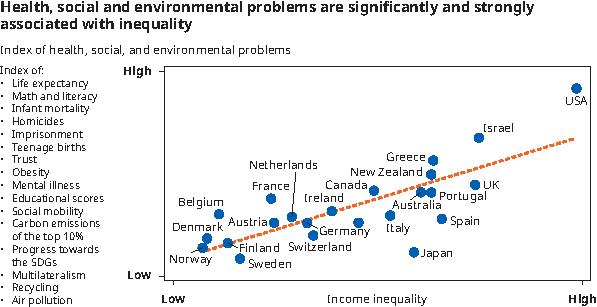
Figure 1.4 Index of Health and Social Problems by Income Inequality in Select Countries
Health and social problems are worse in more unequal societies. The graph depicts the relationship between income inequality and indicators of social dysfunction.
Source: Pickett, K., Gauhar, A., Wilkinson, R. Sahni-Nicholas, P. (2024). The Spirit Level at 15. London: The Equality Trust. doi:https://doi.org/10.15124/yao-de9s-7k93.
For these reasons, social inequality is a fundamental concern of sociology. No academic discipline focuses as much on inequality, which has been sociology’s main concern since the discipline’s founding. Sociologists examine the extent of inequality, how things became this unequal, and why inequality persists. Our main theme in this textbook will be social inequality, which we will use as a vehicle to navigate the vast and varied terrain of sociology. Our guiding question throughout will be, What are the sources and consequences of social inequality?
Inequality and Power
When sociologists examine the causes and consequences of social inequality, they are studying power—the capacity for action. Groups that are ranked higher in a stratification order have more power than those ranked lower. Sociologists define a majority group as a group that has more power over their lives as compared to a corresponding minority group. The majority/minority distinction, for sociologists, is thus not a matter of relative population size, as some people think, but power differences.
19Black Lives Matter (BLM)—a social movement protesting police brutality and other racially motivated discrimination and violence against Black people—has successfully drawn attention to racial inequality and majority/minority relations in the United States by highlighting the disproportionate police violence against African Americans (Clayton 2018; Ross, Winterhalder, and McElreath 2020). A social movement refers to group action meant to challenge (or preserve) existing power structures. Originally formed in 2013 as a response to the murder of 17-year old Trayvon Martin, BLM made international headlines in 2020 after the brutal murder of George Floyd by the policeman, Derek Chauvin, sparked national and global outrage and the largest civil rights protests in generations (Smith 2020). According to BLM, police brutality is a symptom of a bigger problem: that U.S. society devalues Black lives. This claim is backed up by countless sociological studies showing that the legacy of slavery and racial segregation helped create an enduring system of systemic racism that is embedded within social organizations, is buttressed by institutional power, and oppresses certain groups (Buggs et al. 2020). In response, BLM has “committed to struggling together and to imagining and creating a world free of anti-Blackness, where every Black person has the social, economic, and political power to thrive” (Black Lives Matter n.d.). Systemic racism is but one example of how majority groups, intentionally or not, use their power to create further advantages for themselves, often by disadvantaging others. Sociologists also study how disadvantaged minority groups deal with oppression in everyday life and how they sometimes mobilize to challenge the powerful and change society for the better by empowering the powerless. The BLM movement, and the Civil Rights Movement (1954–1965) before it, is a good example of this kind of mobilization (Clayton 2018). One of BLM’s primary demands is criminal justice reform. Most Americans, across racial and ethnic groups, now support Black Lives Matter (Parker, Horowitz, and Anderson 2020).
20Studying power draws attention to the ways in which social inequality is socially constructed. Humans socially construct, or co-create, understandings of the world that, in turn, underpin shared assumptions about reality. We learn these shared meanings through socialization—the lifelong process by which we learn the beliefs, norms, and values of our society. We either perpetuate these meanings by taking them for granted as we go about our lives, or we challenge these meanings to create a more just society. Not all groups, however, have the same power to have their worldview become the accepted view of reality. Given their influence over social institutions, majority groups are better positioned than minority groups to impose their definitions of reality on the rest of the population, in the form of meanings that typically solidify the already privileged position of the powerful.
Traditional gender stereotypes are a good example of how ideas create and maintain inequality. A stereotype is an oversimplified and overgeneralized belief about all members of a social group. Men, for example, have dominated nearly all societies throughout history. Male dominance has been entrenched by sexist ideas and stereotypes that men are inherently superior to women and should, therefore, hold the most powerful positions, get the most rewards for their work, and command the most respect. These ideas have been used to legitimize gender inequality and justify extensive restrictions of women’s public and private lives.
Shared meanings arise, in part, from social structure. When the social institutions that make up the social structure change, our ideas tend to change as well. Western countries, for example, have become more gender equal in recent decades alongside growing secularization, deindustrialization, and the rise of an increasingly knowledge- and service-based economy. These social changes have created more opportunities for women, which has led to changes in gender roles. It is no longer considered unusual for young women to want a successful career and a family. The feminist movement, moreover, has helped undermine traditional gender stereotypes and empower women. Although women have made great strides, no country has reached full gender equality (World Economic Forum 2023).

Beauty standards are socially constructed and vary across time and space.
Keystone Press/Alamy Stock Photo
Finally, we must distinguish between analytical questions and moral questions when studying inequality, power, or other key sociological issues. Although their interest in a topic might be motivated by what they see as a moral problem, sociologists use research to ask and answer analytical questions. An example of an analytical question could be, How does sexism perpetuate economic inequality? Regardless of political leanings, people should be able to consider an analytical question like this one without having their emotions or convictions cloud their judgment. Moral questions, in contrast, tend to evoke strong emotions. An example of a moral, as opposed to an analytical question, would be, How much is too much inequality? The answer to moral questions varies based on people’s moral philosophies, making it difficult to reach an agreement.
21In our case, we agree with Schwalbe (2015:9), who argues that inequality becomes a problem when “some people are able to enjoy life and develop their potential as human beings, while others, perhaps struggling merely to survive, are unable to do this. A decent standard of living, opportunities to develop one’s potential, and equitable reward for one’s labor are what I take as basic human rights. Any time a condition of inequality denies these rights, I find it morally problematic.” Now you know where we stand on the moral issue of inequality. Regardless of where you stand, however, you can rest assured that the questions that we will address in this text will be primarily analytical.
Food for Thought: Sociology Makes the Strange Familiar and the Familiar Strange

Icelandic traditional food.
imageBROKER.com/Alamy Stock Photo
Gummi—one of this textbook’s authors—has a taste for singed and boiled sheep’s heads. Let us explain. Although Iceland is one of the world’s most prosperous countries, its history since its settlement by Vikings in 874 has also been “marked by abject poverty, foreign rule, deadly epidemics, and natural disasters” (Jóhannesson 2013:xi). And, like other poor people, Icelanders had to make do. This manifested itself in the people of Iceland (an agricultural society until World War II) eating everything their most common livestock, the Icelandic sheep, could offer.
By the time Gummi was born in 1978, it had become popular among Icelanders to attend Þorrablót (transliteration = thorrabloat): midwinter festivals to celebrate Iceland’s cultural heritage. The original meaning of Þorrablót is a feast to honor the Norse god Thor; Icelanders were mostly pagan until turning Christian in the year 1000. At a Þorrablót, people eat traditional food, consisting mainly of seafood and sheep products that have been cured, dried, fermented, or pickled, allowing the food to be stored through long winters.
Moreover, just like Gummi learned to be proud of Iceland’s history and the Icelandic way of life, he was taught to appreciate these food items by family and friends. “Real Icelanders eat traditional food,” they said. Eating this food was thus, for him, part of learning what it means to be Icelandic. By learning about the culture of his home country, you may better understand Gummi’s “weird” taste in food. You might even have a similar story to tell about a family delicacy. Sociology makes the familiar strange and the strange familiar (Berger, 1963).
Levels of Analysis
22To understand how society works, sociologists gather and analyze relevant data using systematic research methods. They then seek to identify and explain social patterns in light of their findings. To identify and make sense of social patterns, sociologists use theory, a set of statements that explain the relationships between certain phenomena. Theories are our most comprehensive descriptions and explanations of what, why, and how things happen because they rest on systematic research and are revised in light of new discoveries. Theoretical perspectives are like different types of lenses through which you view the social world; each focuses your attention differently. An important distinction in this regard involves the level of analysis, which refers both to one’s primary assumptions about the relationship between individual interactions and broader social patterns, and research methods of choice. To illustrate, imagine that you use your smartphone to take a couple of selfies. Unaltered, the photographs will give others a decent idea of what you look like, but the photographs will convey little about the community you live in, which helped shape you as a person.
Imagine, in contrast, that you fly a drone equipped with a camera and snap aerial photographs of your hometown. This approach can give others a good overview of your community, its size, geography, major industries, level of affluence, and so forth. While a selfie provides an image of your appearance, the drone shows the “big picture” of where you are from, which helps put you and your experiences in context. Both visuals provide valuable information. They work, however, best in tandem because, as C. Wright Mills (1959/2000) argued, one cannot really understand an individual or their society without understanding both.
For sociologists, different levels of analysis allow us to examine the same topic from different perspectives. At one end of the spectrum, we have microsociology, a level of analysis that focuses on the study of everyday experiences and interactions in small groups to uncover how they contribute to broader social patterns. At the other end of the spectrum, there is macrosociology, an approach that focuses on whole societies and how broad social patterns affect individual and group lives.
All sociologists are interested in the relationship between microscopic (small-scale) and macroscopic (large-scale) social phenomena. The academic field of sociology, moreover, is concerned with the micro-macro continuum in its entirety. Broadly speaking, the micro perspective starts from the “bottom-up” assumption that individual interactions shape broad social patterns by establishing shared meanings and constructing order. The macro perspective, in contrast, operates on the “top-down” assumption that broad social patterns shape individual interactions. The micro-macro dichotomy overlaps significantly with other important divisions within sociology. Let’s take a closer look at how these divisions and their relationships to micro- and macro-approaches inform the kinds of questions asked by sociologists.
Microsociology
As the word micro (meaning small) suggests, microsociology concentrates on the smallest building blocks of society—everyday social interactions—to understand how they come together to structure the social world. Max Weber was the first to argue that sociological analysis should emphasize social action: actions where the acting individual considers the actions and reactions of others. As such, social action forms an integral part of social interaction, where two or more people react to one another. Social interaction lies at the heart of all human behavior—the subject matter of sociology. Over time, the choices we make during social interactions create behavior patterns that structure society. Behavior patterns, in turn, solidify into both informal and formal norms and so do the social positions we occupy relative to others as we develop shared expectations of how people in these positions should act. Put differently, we create society through our interactions, and, at the same time, we become products of society because we are socialized into the culture of the society we constructed.
Erving Goffman’s Presentation of Self in Everyday Life (1959) is a classic example of microsociology. Using the theater as an analogy to study everyday interactions, Goffman argues that individuals try to convey favorable impressions of who they are to others by altering their presentation of self, depending on the audience. The self refers to our sense of who we are as individuals. At work, we want to project the image that we are conscientious; in the classroom, that we are studious; on a first date, that we are comfortable and likeable.

Everyone engages in impression management.
iStockphoto.com/lemono
23By engaging in impression management, people alter the type of self they perform to others depending on what social role takes precedence in any given situation. Social role refers to the set of shared expectations that come with each social position (such as what we expect from a police officer or a typical college student). Our respective audiences judge our performance based on the script that comes with every role. Failure to conform to the script can jeopardize one’s credibility. Regardless of our role, we know that we must play our part well, say the right lines and use the right props. Otherwise, we risk ruining the whole show and undermining our sense of self. As such, social roles are a fundamental component of social structure. They contribute to social stability by allowing people to anticipate how others will behave and pattern their own behavior accordingly. Goffman’s (1959) research shows how the roles each of us plays form a part of society and inform our own understanding of who we are as individuals.
One key division between micro- and macro-approaches is between positivist and interpretive sociology. Interpretive sociology operates at the micro level. It is concerned with how small groups of individuals understand social phenomena; it does not try to predict their behavior. Interpretive sociologists tend to adhere to the micro-perspective; emphasize agency over structure; and to use qualitative methods, that is, methods that do not produce data in numerical form. While positivists (as we shall see next) rely on quantitative analysis, qualitative researchers utilizing qualitative methods use quotes, observations, or descriptions to support their claims. Examples of qualitative methods include unstructured interviews and participant observation. The latter method, for instance, is used to study behavior in its natural setting: where a researcher might, for example, study a crack-selling gang up close for an extended period (Venkatesh 2008).
Macrosociology

A town square in Prague, Czech Republic. Macrosociology is analogous to viewing a crowd of people from the 15th floor of a building.
iStockphoto.com/anouchka
24Positivist sociology, as we learned earlier, originated with Comte, who argued that the social world could be studied using the same methods as the natural world. Positivists tend to adhere to the macro-perspective; emphasize structure over agency; and to use quantitative methods, which involve the gathering, analysis, and presentation of numerical data. While sociologists who followed Comte, like Durkheim, refined Comte’s positivism to fit better the study of society, the objective remains to reveal the “social facts” that shape social life. Comte thought that “social physics” could discover universal “laws” that govern society, but contemporary positivists are much less deterministic in their approach and do not argue that social phenomena operate the same way across time and space.
The standard practice among positivist sociologists when it comes to asking and answering analytical questions about relationships between social phenomena is to come up with a testable hypothesis; test it by analyzing empirical data; accept or reject the hypothesis; and revise one’s original theory accordingly. A hypothesis is a proposed explanation for a phenomenon that needs to be tested with empirical data before it can be accepted as a valid theory. Every basic science makes use of this series of steps to ensure objectivity and consistency when it comes to researching a problem. Collectively, these steps are referred to as the scientific method and the positivist approach is sometimes called the “normal science” model of sociology.
Each side of the distinctions within sociology has its advantages and disadvantages. Choosing between them, or opting for a mix of the two, depends largely on the questions that interest the researcher. For example, whereas quantitative methods are generally used to answer questions of “what” social factors strongly correlate with certain beliefs and behaviors, qualitative methods are generally used to address questions of “why” people hold said beliefs or “how” people go about committing certain acts. A survey can identify what factors predict continued marijuana use; however, participant observation or in-depth interviews would be better to learn about how people learn to smoke marijuana for pleasure (Becker 1953).
Sociology represents at its core a conversation between theory and research. If we want to know why people think and act the way they do, we need to study exactly that. We need to observe people, ask them questions, participate in their everyday lives, or in other ways come
Culture Crossing
Sociology is one of several academic disciplines that examine aspects of the social world. Other social science disciplines include anthropology, economics, and political science. What then distinguishes sociology from the other social sciences? Three things are distinctive about sociology: the intellectual activity of looking at society through the sociological eye (Collins 1998); a focus on comparison and generalization over the particular (Durkheim 1895); and studying the world from the standpoint of civil society (Burawoy 2014). Civil society refers here to institutions, organizations, and movements that are neither part of the state (government) nor the market (economy). Below, we elaborate on these last two points and discuss author Gummi’s status as an insider/outsider in the United States, and the importance of adopting a beginner’s mind for a student of sociology.
25As Durkheim argued in The Rules of the Sociological Method (1895), all sociology is implicitly comparative because social phenomena are treated as either typical, representative, or unique cases, all of which assume comparison. “Comparative sociology is not a particular branch of sociology,” Durkheim observed; “it is sociology itself, in so far as it ceases to be purely descriptive and aspires to account for facts” (Durkheim 1895:138). That said, some sociological approaches are more explicitly comparative. This applies particularly to research that is concerned with cross-national differences and similarities. We learn a lot from explicit cross-national comparison, for example, about the effects of different levels of social integration on suicide rates (Durkheim 1897/1951); how different welfare policies impact absolute and relative poverty (Kenworthy 1999); and how ideas of femininity and masculinity vary across cultures and how these gender norms and practices emerged initially (Human Relations Area Files 2017). Cross-national comparison challenges our common-sense ideas of what is “normal” and “natural.” In so doing, comparative research fosters cultural awareness (i.e., the ability to assess our own and others’ norms, values, beliefs, and perceptions in an objective manner).
Researchers in other disciplines, most notably, cultural anthropologists, also study different countries and cultures. These researchers, however, tend to focus more on the particularities of a specific group, whereas sociologists tend more toward comparison across cultures. In light of that, each chapter that follows will have a section primarily devoted to cross-national comparison or another country to highlight how different cultures do things differently. In this first chapter, however, we compare sociology with other social science disciplines.
As the late British sociologist Michael Burawoy (2014) highlights, sociology arose with civil society as a response to the ascent of the capitalist market economy in the late 19th century. Durkheim was, for example, concerned that capitalism bred social isolation and unhappiness; Marx saw capitalism giving rise to excessive inequality; Weber feared that economic logic would stifle human creativity; and Du Bois argued that capitalism underpinned racism. All four wanted to understand the changes wrought by industrial capitalism and each, in their own way, suggested how these changes should be met or managed. Thus, from the beginning, sociology has taken a stand with civil society against both the overreach of markets but also that of the regulatory state. This orientation distinguishes sociology from economics, which studies the world from the standpoint of markets, and political science, which studies the world from
Most American sociology textbooks are written by cultural insiders, that is, people who have lived all, or most, of their lives in the United States. This is the case with two of this textbook’s authors—JT and Jenny—who can draw on their lifelong experience and vast knowledge as cultural insiders as well as their sociological expertise. However, a distinguishing feature of this textbook is that its lead author, Gummi, is both a cultural insider and a cultural outsider, which adds a unique and valuable perspective.
Specifically, Gummi was born and raised in social-democratic Iceland—one of the world’s smallest, most homogeneous and egalitarian countries. From 2007 to 2017, however, Gummi lived, studied, and taught in the United States—one of the biggest, most diverse, and unequal countries on the face of this planet—and he maintains close connections to his “second home country.” Moreover, his insider/outsider status in U.S. society gives him a unique perspective to analyze social patterns and processes that an insider might take for granted. “Sharp is the guest’s eye,” as the Icelandic saying goes.
In this sense, Gummi is like the “stranger” as conceptualized by the German sociologist Georg Simmel (1971); that is, someone who is in the group but not of the group. In Gummi’s case, he lived here in the United States for more than a decade and yet, in a sense, he was and remains distant from the cultural insiders. This distance stems from Gummi’s cultural origins and not having been socialized into American society from an early age. This cultural distance grants him a unique perspective and certain objectivity when observing social phenomena that an American might see as “natural,” helping him see the general in the particular.
26Finally, we want to suggest a strategy that can help you see the “general in the particular” by removing the blinders from your sociological eye. The strategy in question entails adopting what Zen Buddists call shoshin (a beginner’s mind) (McGrane 1994). A beginner’s mind means being eager, open, and unbiased by preconceived notions when studying something. Our old ideas frequently prevent us from making discoveries. A beginner’s mind, in contrast, allows you to “bracket” what you already know and simply observe. Making discoveries is usually not about finding something new, “but rather a new way of seeing things” (McGrane 1994:3).
This is the essence of sociology: It is not about long-dead Europeans and facts. It is a new way of knowing and seeing society that will always serve you well. As Collins (2017) poetically observes, “The sociological eye holds up a periscope above the tides of political and intellectual partisanship, spying out the patterns of social life in every direction.”
Why a Sociology Major?
Does what you have learned about sociology pique your interest? If so, consider majoring or minoring in sociology. In addition to making you a more thoughtful, empowered, and engaged citizen, sociology is an excellent springboard for the 21st-century job market as well as further professional study in various fields, such as medicine, business, or law. Sociology majors are sought after because they know how to ask and answer important questions about current social realities by systematically gathering, analyzing, and interpreting data. Moreover, the sociological way of knowing is transferable, making it easier for sociology majors to switch jobs and occupational sectors. Sociology majors are also at an advantage because many occupational sectors are based on sociological insights. Businesses, government agencies, and not-for-profit organizations want people who understand the dynamics of culture, globalization, and inequalities; can work with qualitative and quantitative data; and can communicate findings to expert and lay audiences alike. The study of sociology is also excellent preparation for graduate school in a wide range of fields, including education, public policy, social work, and, of course, sociology. Graduate study allows you to become an expert in areas that most fascinate you. In any case, follow your passion.
Act Now
In 1995, Craig Kielburger, 12, along with his older brother, Marc, gathered a group of